



When renewables.GE spoke with Vynity co-founder Giorgi Jalagonia in September 2026, the Georgian energy-tech company was already developing tools that extended beyond conventional electricity generation forecasting.
Since then, Vynity has taken an important step in its commercial development. In October, its forecasting services began operating within Turkish energy platforms, providing the company with access to a larger and more developed electricity market.
According to Jalagonia, Vynity now serves three portfolios in Türkiye, covering approximately 60 generation and consumption entities. In Georgia, the company continues to work with around 35 power plants.
Its international expansion comes alongside the development of new electricity market simulation, investment assessment and trading support tools, broadening the company’s activities beyond generation forecasting.
Entering Türkiye through partnerships
Vynity’s approach to the Turkish market differs from the one it initially pursued in Georgia.
The company began commercial operations in Georgia in April 2025, establishing relationships directly with individual power producers. Integrating each plant required access to historical data, technical discussions, parallel forecasting tests and the gradual development of trust.
Although that experience helped Vynity understand the operational characteristics of individual generating facilities, entering a significantly larger market required a different commercial model.
In Türkiye, the company integrates its services into existing energy platforms through local partners. These platforms already serve producers, consumers and portfolio operators, enabling Vynity to reach multiple market participants through a single integration.
The inclusion of both producers and consumers is commercially important. Portfolio operators must manage deviations in electricity generation as well as consumption, and both can contribute to their overall imbalance exposure.
Jalagonia also emphasises the importance of contractual arrangements, confidentiality and data management. Before forecasting could begin, the company had to establish how information could be accessed and processed within its partners’ existing contractual relationships.
“Nobody puts that in a press release, but it’s what decides whether a project like this actually starts.”
The partnership model is intended to support further expansion without requiring the company to establish a separate integration process for every end customer.
Forecasting in a market that prices uncertainty
Generation forecasting and imbalance forecasting have been the principal services behind Vynity’s entry into Türkiye.
For renewable electricity producers, deviations between scheduled and actual generation create financial exposure through the balancing and settlement arrangements of the electricity market.
The financial consequences depend not only on the volume of the deviation but also on prevailing market prices. A forecasting error during one trading period may therefore have a considerably different financial impact from an equivalent error during another.
As Jalagonia puts it:
“In Turkey, a forecast error is not an inconvenience, it’s an invoice.”
Vynity provides generation forecasts at hourly resolution, covering horizons ranging from one hour to one year ahead. Its imbalance forecasting services help portfolio operators assess their anticipated position relative to wider electricity system conditions.
The company has also developed electricity price-direction signals and bid optimisation tools to support trading decisions. Trading actions remain subject to approval by human operators.
For energy-market participants, this extends the role of forecasting from predicting physical electricity production to assessing the commercial consequences of operational and trading decisions.
Preparing for shorter settlement periods
An important development for Vynity’s Turkish operations is the planned introduction of 15-minute settlement periods in the balancing power market.
An amendment to Türkiye’s Electricity Market Balancing and Settlement Regulation, published in the Official Gazette on 21 January 2025, establishes 1 January 2027 as the deadline for the necessary infrastructure preparations.
Shorter settlement periods increase the importance of understanding changes in generation and consumption within individual hours. This is particularly relevant for wind and solar producers, whose output can fluctuate significantly over relatively short periods.
Vynity is adapting its forecasting models to the finer time resolution.
According to Jalagonia, the company has accumulated more than seven years of historical Turkish wind data. Its internal monitoring also identified a change in the resolution of wind data published through EPİAŞ, Türkiye’s energy exchange, in May 2026.
The company’s experience illustrates how forecasting services must evolve alongside market rules, data availability and settlement arrangements.
From forecasting to market simulation
Vynity’s expansion is also accompanied by the development of two new products, currently in preview: the Market Simulator and the Investment Simulator.
The Market Simulator is designed to help electricity market participants evaluate how changes in underlying market conditions could influence future electricity prices and commercial positions.
Users can adjust assumptions relating to electricity demand, hydropower availability, wind and solar production, fuel prices and cross-border electricity exchanges. The platform then calculates potential changes in electricity prices under the selected scenario.

Vynity’s Market Simulator preview, comparing scenario-based electricity price projections with the company’s reference outlook and market prices. Image: Vynity.
For example, a market participant could examine how a reduction in hydropower generation during a dry season might affect electricity prices, or assess the combined consequences of higher electricity demand and reduced wind output.
The simulator also incorporates a method for estimating how individual factors contribute to the overall change in modelled prices. This can help users distinguish the influence of different market drivers rather than examining only the resulting price.
According to Vynity, the simulator is built on a plant-level representation of Türkiye’s electricity system, supported by historical hourly market data.
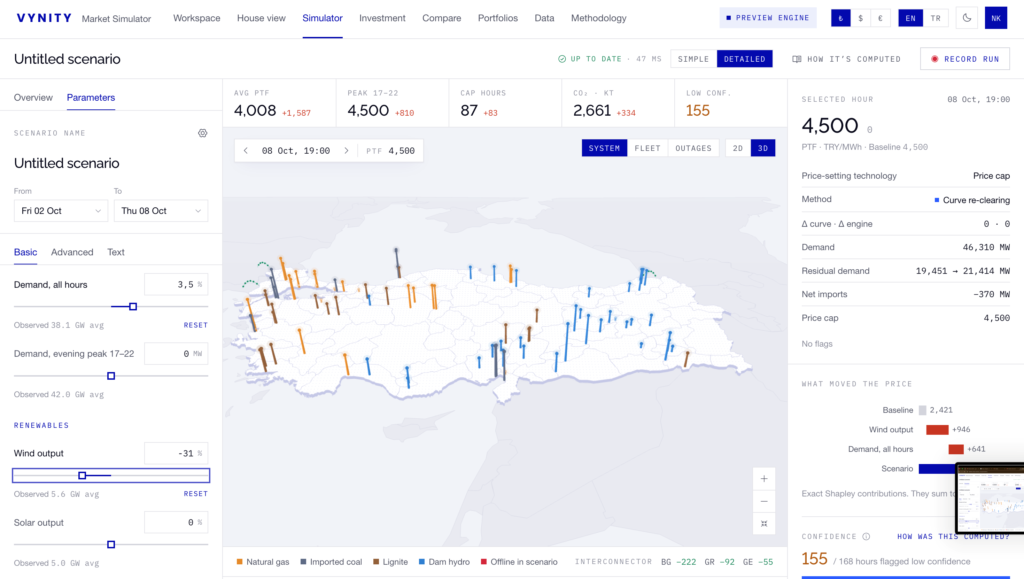
The Market Simulator’s Turkish electricity system view, illustrating the potential price effects of changes in electricity demand and wind generation under a modelled scenario. Image: Vynity.
Assessing new renewable energy investments
The Investment Simulator applies the same underlying market model to prospective power generation projects.
A developer considering a new renewable energy facility can introduce assumptions about its location, installed capacity, generation profile, construction costs, financing structure and grid connection.
The proposed facility can then be assessed against modelled hourly electricity market conditions, including its potential revenues and exposure to different market scenarios.
The tool is designed to calculate investment indicators such as internal rate of return (IRR), payback periods and debt-service coverage.
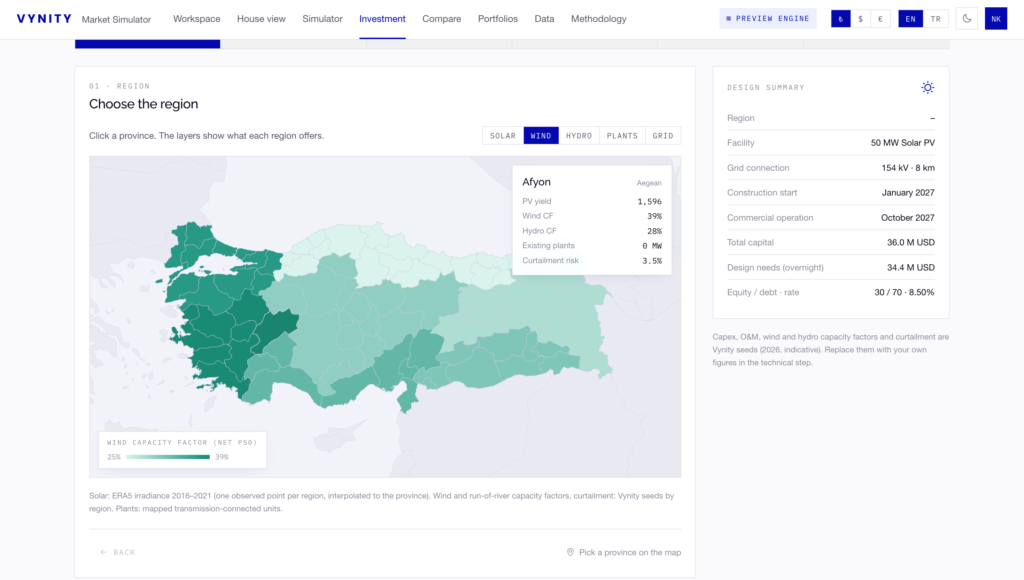
Vynity’s Investment Simulator preview, displaying indicative regional wind capacity factors and example assumptions for renewable energy project development in Türkiye. Image: Vynity.
For developers and financial institutions, this approach could complement traditional project assessments, particularly as the commercial performance of renewable generation becomes increasingly dependent on the timing of electricity production and prevailing market conditions.
Understanding portfolio exposure
The platform also allows users to examine the combined commercial performance of different generation assets, consumption profiles and electricity contracts.
This enables portfolio-level assessment of electricity sales and purchases, contract settlements, imbalance costs and overall financial performance under alternative market conditions.

An illustrative portfolio assessment combining solar and wind generation, industrial consumption and electricity contracts. The dashboard compares modelled revenues, costs and imbalance exposure under baseline and alternative scenarios using a synthetic portfolio. Image: Vynity.
Both simulation products are expected to move from preview to commercial availability during the first quarter of 2027.
Measuring forecasting value beyond accuracy
Vynity’s Turkish experience is also influencing how the company evaluates the performance of its forecasting models.
One of its internal assessments examined approximately 6,774 hourly observations between 1 January and 10 October 2026, testing the model’s ability to anticipate balancing price direction relative to the day-ahead market and the direction of system imbalances.
According to Jalagonia, on the half of predictions where the model expressed greater confidence, accuracy reached approximately 70% for price direction and 75% for system direction.
The company reports that the model was retrained monthly using previously settled data, with the methodology established before the 2026 evaluation period.
While these are internal performance assessments, Vynity is also conducting parallel operational tests with its Turkish partners to evaluate the financial value of its forecasts after trading and settlement costs.
Jalagonia argues that conventional accuracy measures alone cannot adequately describe the commercial performance of electricity forecasting services.
“An error in an expensive hour costs many times more than the same error in a cheap one.”
The company is therefore placing increasing emphasis on assessing forecasting performance in monetary terms.
Bringing market experience back to Georgia
Despite its international expansion, Georgia remains an important market for Vynity.
The company’s Turkish operations provide practical experience with electricity market arrangements that differ significantly from those currently operating in Georgia.
Georgia’s transitional electricity market model retains monthly balancing arrangements. The target market model, scheduled for introduction on 1 July 2027, envisages hourly imbalance responsibility and the operation of balancing and ancillary services markets.
Moving from monthly to hourly imbalance responsibility would increase the commercial importance of accurately forecasting generation and consumption during individual trading periods.
For Vynity, its Turkish experience offers an opportunity to develop and test settlement-related services before their wider application in Georgia.
However, local operating conditions still require dedicated modelling. Georgia’s hydropower resources, individual river catchments, upstream cascade operations and relatively limited historical wind generation data present challenges that cannot be addressed simply by transferring models developed for another country.
The company intends to continue developing these local capabilities while introducing its simulation tools to Georgian developers and electricity traders.
Vynity’s plans for 2027
By the end of 2027, Vynity aims to expand its Turkish operations from three portfolios to ten, serving approximately 200 generation and consumption entities.
The company is targeting around 1 GW of wind and solar capacity covered by its forecasting services in Türkiye.
Alongside this expansion, Vynity plans to commercialise its two simulation products in the first quarter of 2027, secure at least five paying clients for them by year-end and introduce additional trading-support algorithms.
In Georgia, its priorities include expanding the visibility of its existing services, making the simulators available to local market participants and preparing its forecasting products for hourly settlement.
Jalagonia describes the intended direction of the company in broader terms:
“It becomes a platform of forecasts, simulators and trading algorithms.”
For Vynity, 2027 will therefore be a year of both international expansion and product development, with experience gained in Türkiye informing its preparations for Georgia’s evolving electricity market.
Related reading: Giorgi Jalagonia: Why AI Forecasting Could Become Infrastructure for Georgia’s Renewable Energy Market
Source note: Based on written responses provided by Giorgi Jalagonia, Co-Founder and CEO of Vynity, to renewables.GE, November 2026. Regulatory context: Türkiye’s Official Gazette, 21 January 2025; Energy Community implementation reporting and Georgia’s Electricity Market Model Concept.